Beltman, S. ; Mansfield, C. & Price, A.(2011). Thriving not just surviving: A review of research on teacher resilience.Educational Research Review, 6(3),185-207
Leer aquí
Uriarte, J.(2006). Construir la resiliencia en la escuela. Revista de Psicodidáctica, 11 (1), 7-23
Leer aquí
Fontaines, T., & Urdaneta, G.(2009) Aptitud resiliente de los docentes en ambientes universitarios. Revista de Artes y Humanidades UNICA, 10(1), 163-180
Leer aquí
Combes, L. (2007) Beginning teachers, resilience and retention. Ph D Dissertation.Texas State University-San Marcos
Leer aquí
Howard, S., & Johnson, B. (2002). Resilient teachers: Resisting stress and burnout. Abstracts AARE- 2002
Leer aquí
Simon, A., et al (2009) Research on the Effect of the Inner Resilience Program on Teacher and Student Wellness and Classroom Climate.Final Report. N.York: Metisassociates
Leer aquí
Cabello, Rosario; Ruiz-Aranda, Desirée & Fernández-Berrocal, Pablo (2010). Docentes emocionalmenteinteligentes. REIFOP, 13 (1).
Leer aquí
http://www.aufop.com/aufop/uploaded_files/articulos/1268615555.pdf Sigue leyendo →
De panzazo (Documental sobre la educación mexicana. “El proyecto se desarrolló por tres años entrando en la realidad de los alumnos y sus familias, captando la dinámica cotidiana de escuelas en lugares tan diversos del territorio nacional como Ciudad Juárez, el interior de Yucatán, Morelia, las sierras de Chiapas y Guerrero, así como Naucalpan e Iztapalapa en la zona metropolitana de la Ciudad de México” http://www.depanzazo.mx/pelicula.aspx
REVISTA ESPAÑOLA DE EDUCACION COMPARADA,
SISTEMAS EDUCATIVOS EXCELENTES NÚMERO 18, 2011
HANS-GEORG KOTTHOFF, Between Excellence and Equity: the Case of the German Education System (ENTRE LA EXCELENCIA Y LA EQUIDAD: EL CASO DEL SISTEMA EDUCATIVO ALEMÁN)
DAVID CROOK, Standards in English Education: An Enduring Historical Issue (LA CALIDAD EN LA EDUCACIÓN INGLESA: UNA CUESTIÓN HISTÓRICAMENTE RECURRENTE)
ANTHONY WELCH, PISA Performance and Australian Education: Myths and Realities (EDUCACIÓN EN AUSTRALIA Y RENDIMIENTO EN PISA: MITOS Y REALIDADES)
CLARA MORGAN, Education in Canada: in Pursuit of Educational Quality and Equity (EDUCACIÓN EN CANADÁ: A LA BÚSQUEDA DE UNA EDUCACIÓN DE CALIDAD Y EQUIDAD)
MARÍA JOSÉ GARCÍA RUIZ, Contrastes de las Culturas Escolares Finlandesa y Española (CONTRASTS BETWEEN FINNISH AND SPANISH SCHOOLING CULTURES)
MARÍA JOSÉ GARCÍA RUIZ Y CARMEN ARECHAVALETA PINTÓ, ¿Cuáles son las Razones Subyacentes al Éxito Educativo de Corea del Sur? (WHICH ARE THE UNDERLYING REASONS FOR THE EDUCATIONAL SUCCESS OF SOUTH KOREA?)
M.F. Taşar & G. Çakmakcı (Eds.), Contemporary science
education research: international perspectives. Ankara, Turkey: Pegem Akademi.
This book includes a collection of papers on the following topics:
The Nature of Scientific Content
Structure and essence of scientific content, how scientific content differs fromother contents; visualization, metaphors, models, modeling, analogies, simulations, and animations in science and their use in science education
History, Philosophy and Sociology of Science
Historical, philosophical and social issues of science, nature of science, and epistemology of science as they are related to science education
Informal Outdoor Science Education
Developing and evaluating the impact of programs and experiences outside the classroom by institutions and organizations other than schools (i.e. museums, science and technology centers, zoos and botanical gardens, scientific research laboratories, and outreach centers) and learning experiences through mass media (in print, film, broadcast, electronic, etc.)
Science Curriculum and Evaluation
Curriculum development, reform, implementation, dissemination and evaluation, and international comparison studies such as TIMSS, PISA, ROSE; evaluation of schools and institutions
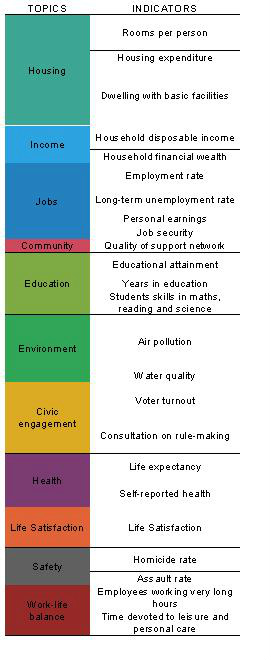
La OCDE está desarrollando bases de datos para comparar los avances de los 34 países que la conforman en relación a 11 tópicos que permitan una visión más amplia del desarrollo. La propia OCDE reconoce el sesgo más economicista que ha tenido el valorar el desarrollo solo desde variables económicas:
“Ever since the OECD started out in 1961, GDP has been the main factor by which it has measured and understood economic and social progress. But it has failed to capture many of the factors that influence people’s lives, such as security, leisure, income distribution and a clean environment.
Is life really getting better? How can we tell? What are the key ingredients to improving life – is it better education, environment, healthcare, housing, or working hours? Does progress mean the same thing to all people or in all countries and societies?”
Encuesta Lima Cómo Vamos correspondiente al año 2011, promovido por la Asociación Atocongo, la Asociación Civil Transparencia, el Grupo RPP y la Pontificia Universidad Católica del Perú. Informe completo aquí
La encuesta aborda:
• Evaluación y satisfacción de la calidad de vida en la ciudad
• Percepciones acerca de los principales aspectos de la ciudad
> Seguridad ciudadana
> Movilidad y transporte
> Medio ambiente
> Espacios públicos
> Vivienda
> Deporte y recreación
> Cultura
> Empleo, pobreza y desigualdad
> Educación y salud
• Evaluación de la gestión pública
• Participación ciudadana y cultura cívica
Muestra: 1920 personas mayores de 18 años, residentes en Lima Metropolitana.Fecha de aplicación: Entre el 22 de octubre y el 20 de noviembre del 2011.
< %image(20120709-satisfa_lima_last_last.jpg|429|300|
Ver informe completo aquíSigue leyendo →
Green Peace (2009) Los nuevos conquistadores. Multinacionales españolas en América Latina Impactos económicos, sociales y medioambientales
Leer aquíSigue leyendo →
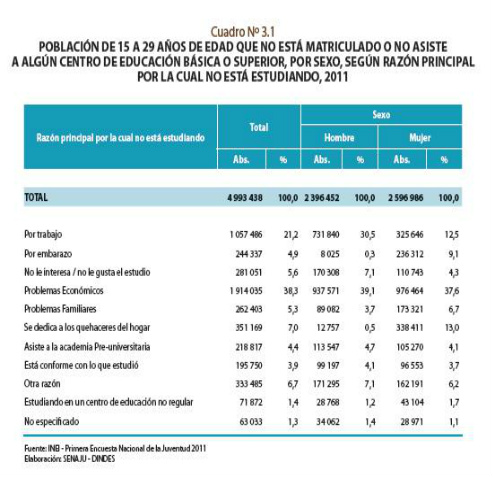
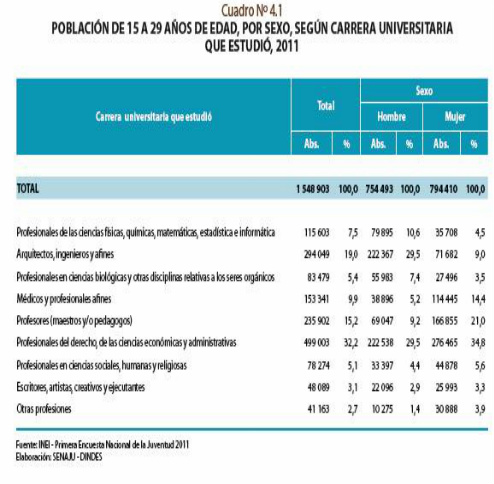
Secretaria Nacional de Juventud. Perú: Resultados Finales de la Primera Encuesta Nacional de la Juventud 2011.
La Primera Encuesta Nacional de la Juventud es el primer diagnóstico de juventudes que nos muestra los siguientes niveles de inferencia: nacional, urbano, rural, costa, sierra, selva y Lima Metropolitana. El tamaño de la muestra fue de 6 900 hogares y se encuestó a 11 042 jóvenes a nivel nacional. En sus capítulos se analiza características: sociodemográficas, educativas, económicas, emprendimiento, expectativa migratoria, participación política, gobernabilidad, salud y la percepción de los jóvenes sobre la situación del país.
Ver informe completo aquí
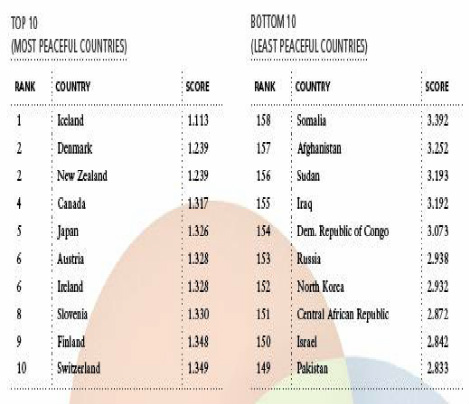
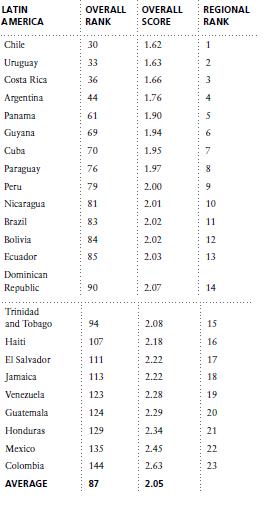
The 2012 Global Peace Index is the sixth edition of the world’s leading study on global levels of peacefulness. The GPI ranks 158 nations using 23 qualitative and
quantitative indicators from highly respected sources, which gauge three broad themes: the level of safety and security in society; the extent of domestic or
international conflict; and the degree of militarisation.
Latin America also experienced an overall gain in peacefulness, with 16 of the 23 nations seeing improvements to their GPI scores since 2011.